The Life of Yee Jock Leong. II: Parents and Siblings
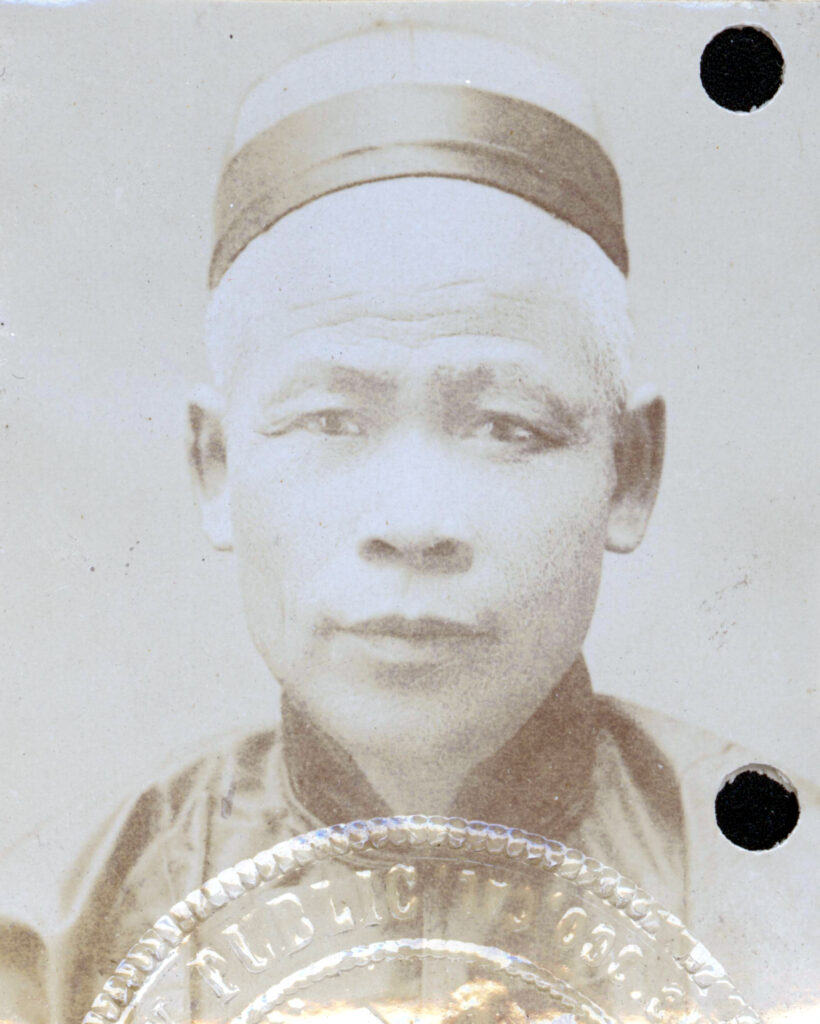
As I learned later, Yee Jock Leong’s father, Yee Kim Wo (right), first came to the United States in K.S. 2nd year (the second year of Emperor Kwang Sui), or 1876. There are no records of when during the year, nor of what ship he came on. I estimate his date of birth to be circa 1850. (This is an unadulterated guess, however.) I do not know when or where Yee Kim Wo married Wong Shee, but they were living on the second floor of a building at 741 Sacramento Street — Yee Kim Wo worked as a merchant at Quong Hing Lung & Co., a general merchandise firm on the ground floor of the building — at the time Yee Jock Leong was born in 1884.
I suspect that Wong Shee was in San Francisco with Yee Kim Wo by 1882, for the first Chinese Exclusion Act was passed by Congress in the Spring of 1882 and signed into law by President Chester A. Arthur on May 6 of that year. The law almost completely prohibited the immigration of Chinese to the United States, because “in the opinion of the Government of the United States the coming of Chinese laborers to this country endangers the good order of certain localities within the territory thereof.” Those who were already in the United States at the time the act was passed, but who left the country afterward, could re-enter the United States ONLY if they had obtained a certificate prior to their departure from a U.S. port. Legal immigrants, such as Yee Kim Wo, were denied U.S. citizenship, however.
Yee Kim Wo held a shaving ceremony for Yee Jock Leong at the Hom Fa Lau Restaurant in San Francisco shortly after the birth. From what I can find out by searching the Web, head-shaving ceremonies are common in East Asia. In Buddhist families, for example, when a baby is about one month old his head is gently shaved and cotton tied around the wrists in the belief that the ceremony will bring blessings to the child. Yee Kim Wo did not offer any details about Yee Jock Leong’s shaving ceremony other than where it was held.
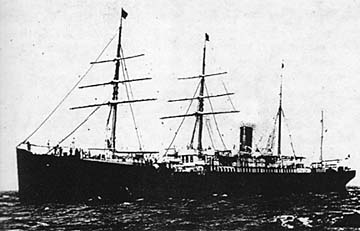
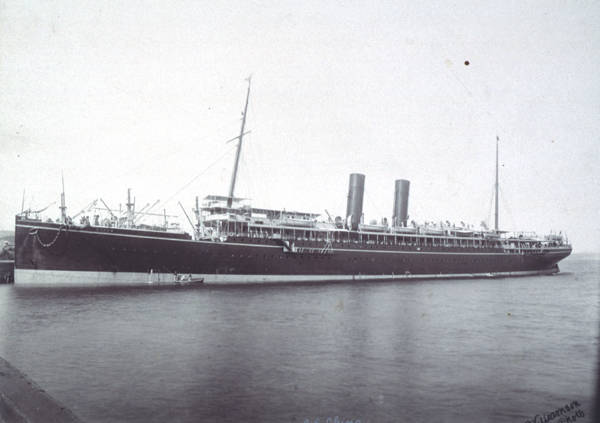
Yee Kim Wo, Wong Shee and Yee Jock Leong left San Francisco for China in K.S. 12th year, 9th month (circa October 1886) on board the S.S. Gaelic (right). The Gaelic, built by Harland & Wolff of Belfast, Northern Ireland, for the White Star Line, was launched on February 28, 1885, and made Pacific crossings for the Occidental & Oriental Steamship Co., from 1885 to 1904. What was arguably the ship’s most historic voyage ended on January 13, 1903, when the ship arrived in Honolulu, Hawaii, with 102 Korean passengers — the first Korean immigrants to what is now the United States. The Gaelic was overhauled by Harland & Wolff in 1905 and sold to the Pacific Steam Navigation Co. the same year, but was retired and broken up in 1907.
Yee Kim Wo settled Wong Shee and Yee Jock Leong in Lee Yin Village, Sun Ning District, in what is now Guangdong Province in southern China. They lived in a five-room house consisting of two bedrooms, two kitchens and a sitting room. Yee Jock Leong, in an immigration interview in 1903, said the house was on the third alley, fourth house from the corner. Yee Kim Wo, in an interview the same year, said that the house was on the second alley, third house from the corner. Both agreed that a river lay in front of the village and hills lay in back. and that the nearest marketplace was Gong May (Gong Mei), about two blocks (between one and two lees) from their home. Yee Kim Wo said their nearest neighbor was a widow, Soo Ho Shee. Her husband was named Yee Foon. (His married name was Yee Jung Toong.) Yee Jock Leong mentioned another neighbor, Yee Wah Due, whose father, Lee Jung Toon, had previously owned the house where Yee Wah Due lived.
Yee Kim Wo returned to the United States without his family one year later, in K.S. 13th year, 9th month (circa October 1887).
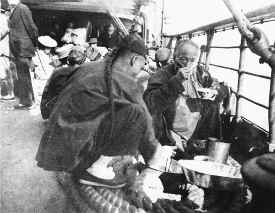
Passage between the United States and China took several weeks, and often included stops at several ports, such as Shanghai, China, and Yokohama, Japan, along the way.
The image at right shows Chinese passengers eating on the deck of the S.S. China about 1901. Note that they are using the huge coil of rope as a rug.
Yee Kim Wo departed San Francisco again on K.S. 16th year, 10th month, 26th day (December 7, 1891) on board the Gaelic. This time he stayed in China for four years, and while there he and Wong Shee had two more children, a son, Yee Suey Leong, and a daughter, Yee Yah Yit. Yee Suey Leong was born circa 1892 and Yee Yah Yit was born circa 1894.
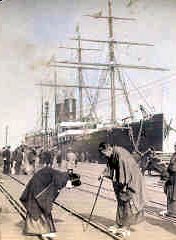
Yee Kim Wo returned to the United States in K.S. 21st year, 4th month (May 27, 1895) on board the S.S. China (above and right). (The S.S. China was involved in a historical event when a General F.V. Green and detachment of troops from the U.S. Philippine Expeditionary Force annexed Wake Island for the United States on July 4, 1898.)
About 1900 Yee Kim Wo joined the firm of Kow Kee Jan & Co., a general merchandise firm at 840 Clay Street in San Francisco. Yee Kim Wo was interviewed at the firm prior to Yee Jock Leong’s return to the United States on April 22, 1903, and Yee Kim Wo is listed as a partner in the firm on May 25, 1903, and on January 8, 1904. U.S. authorities required Chinese businesses to list all partners and the amount of their investment. The CEA prohibited the immigration of laborers, and the government went to great lengths to document whether or not merchants were actually merchants. Immigration authorities could not believe the word of Chinese merchants alone, and interviewed several white businessmen — including James R. Neutzel and William J. Gardner — to corroborate Yee Kim Wo’s contention that he was a merchant. The white businessmen signed an affidavit certifying Yee Kim Wo’s merchant status on April 22, 1903.
Yee Jock Leong later said that Yee Kim Wo returned to China in 1906 and never returned (as of April 14, 1914). Chinatown was destroyed in the great San Francisco earthquake and fire was on April 18, 1906. I do not know if Yee Kim Wo left prior to the earthquake, but is is possible that the disaster prompted his departure.